Environmental Considerations
DOE analyzed environmental issues associated with the project according to National Environmental Policy Act (NEPA) standards. In addition, PSI, Destec, and two environmental consulting firms prepared a detailed environmental information volume providing inputs to an Environmental Assessment for the project. A positive NEPA assessment led to DOE issuing a Finding of No Significant Impact in May of 1993. All Federal, state, and local permits and approvals were obtained in combination with the establishment of a process and environmental monitoring program.
Plant design was conducted with the goal of outperforming the Clean Air Act (CAA) emission standards, which limit sulfur dioxide (SO2) at 1.2 lb/million Btu of fuel input and NOX at 0.15 lb/million Btu. Demonstrated emissions are much under these targets (see linked report below).
Despite power generation at the Wabash River complex being almost three times that of the original unit, the total emissions are a fraction of the pre-powering values as a result of the IGCC system.
Cost/Schedule
Total cost of the project was $438 million, which included construction and operation during the four-year demonstration period. DOE provided $219 million (50%) of the total cost.
A cooperative agreement was reached between Wabash River and DOE in July of 1992 with construction beginning in July of 1993. Operation commenced in November of 1995 and the completion of demonstration activities and turnover to commercial operations began in January of 2000. Unusually severe weather hampered activities in the first year of the construction phase of the project. Seven-day construction schedules were employed with peak construction activity reaching over 1,000 workers on site daily.
Operational History
Over the course of the demonstration, the Wabash River Project processed 1.5 million tons of coal, generating more than 4 million MWh of electricity. Thermal efficiencies of the plant were 39.7% for coal and 40.2% for petroleum coke (higher heating value basis). Plant availability averaged 70% in 1998-99, reaching as high as 77% in any given nine-month average. The plant demonstrated stable operation and was successfully operated on baseload dispatch in the PSI system.
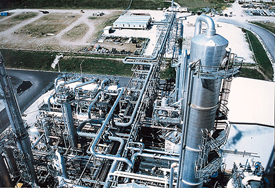
Wabash River IGCC Gas Cleanup System (source)
Initial operations found several problems that have been addressed successfully. Improvements in rod mill operation and installation of a new burner resulted in increased carbon conversion, reducing carbon in the slag from about 10% to around 5 %.
Ash deposition at the inlet to the firetube boiler was corrected by modifying the hot gas path flow geometry and velocity. Breakthrough of particles in the barrier filter system was corrected by replacing the ceramic elements with metallic candles. Early replacement of the COS hydrolysis catalysts, due to poisoning by chlorides and metals, was remedied by the installation of a wet chloride scrubber system and a change of catalyst.
A new mechanical method for cleaning boiler tubes was developed to reduce corrosion and decrease filter blinding. Acid gas removal was improved by expanding the system capacity for removing heat-stable salts from the circulating amine solution.
The expansion bellows between the syngas module and the turbine required redesign to eliminate cracking flow sleeves. Solenoid valves in the syngas purge lines were also redesigned and replaced. Replacement of the fuel nozzles was selected as a solution to cracking combustor liners.
