The Integrated Gasification Combined Cycle (IGCC) application of gasification offers some water-saving advantages over other technologies for producing electricity from coal. Regions with limited water resources, typical of many parts of the western United States, could conserve resources by meeting increasing electricity demand with IGCC generation. Many of these areas have good coal resources and a need for new generating capacity.
Water use in a thermoelectric power plant is described by two separate terms: water withdrawal and water consumption. Water withdrawal is the amount of water taken into the plant from an outside source. Water consumption refers to the portion of the withdrawn water that is not returned directly to the outside source – for example, water lost to evaporative cooling.
The thermoelectric industry is already a huge water user on the national level and must compete with several other applications for water supply. The total quantity of water withdrawn for thermoelectric power in 2005 was estimated by the United States Geological Survey to be 201 billion gallons per day, which was 49% of total water withdrawal, 41% of total freshwater withdrawals for all categories, and 53% of fresh surface-water withdrawals.
Water Use in a Carbon Capture Scenario
If future limitations on carbon emissions require generating plants with the ability to separate and capture carbon emissions, increased water usage will be required for all electrical generating technologies. However, since the IGCC process adapts more easily to CO2 removal, the increase in water use for carbon capture is marginal compared to plants of other types. In fact, in a carbon capture scenario, IGCC plants are nearly as conservative in water consumption as natural gas combined cycle (NGCC) plants. The chart below shows estimated water usage figures for the power plant technologies in both carbon capture and non-capture scenarios.
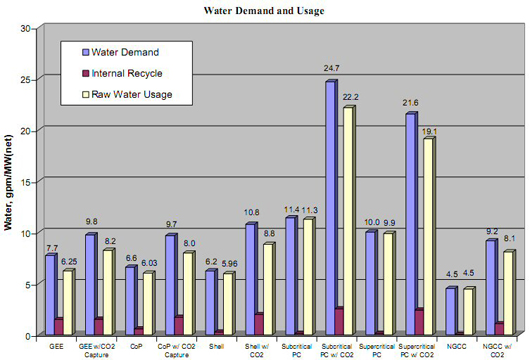
Estimated water usage figures for the power plant technologies in both carbon capture and non-capture scenarios
What can IGCC’s reduced water requirements mean to the nation’s energy and water resources in the future? Combining EIA demand projections and the information in the charts above, IGCC has the potential to save as much as 640,000 gallons per minute or 300 billion gallons per year of raw water by 2030. In the case of carbon capture requirements, 1.9 million gallons per minute or one trillion gallons per year of raw water could be saved.
So, in summary it can be said that gasification-based power offers efficiency benefits in the use of water. Raw water use in IGCC plants is lower than in pulverized coal plants. Without CCS, PC plants have a much higher steam turbine output, requiring more cooling water and condenser duties (typical raw water use ratio of 1.7:1.0). With carbon capture, the difference in water use is even more dramatic (2.5:1.0), as the chemical absorption process for CO2 capture in PC plants (amine) requires even more cooling water. In terms of raw water increase, CO2 capture increases raw water use by 37% for IGCC plants, versus a 95% increase for PC plants.
