Pulverised coal power plants account for about 97% of the world's coal-fired capacity. The conventional types of this technology have an efficiency of around 35%. For a higher efficiency of the technology supercritical and ultra-supercritical coal-fired technologies have been developed. These technologies can combust pulverised coal and produce steam at higher temperatures and under a higher pressure, so that an efficiency level of 45% can be reached (ultra-supercritical plants). Supercritical power plants have become the system of choice in most industrialised countries, while ultra-supercritical plant technology is still in the process of demonstration. Supercritical and ultra-supercritical plants are more expensive (because of the higher requirements to the steel needed to stand the higher pressure and temperature) but the higher efficiency results in cost savings during the technical lifetime of the plants. The emissions of CO2 per MWh delivered to the grid could reduce from 830 kg to 730 kg.
he Dakota Gasification Company's (DGC) Great Plains Synfuels Plant (GPSP) located near Beulah, North Dakota, is the only coal-to-synthetic natural gas (SNG) gasification plant in operation worldwide, producing approximately 153 MM scf/day of SNG [56 billion scf/year] from 6 million tons/year of lignite. In addition to SNG, a variety of byproduct process trains have been incorporated to add flexibility to plant economics: GPSP also produces ammonia for use as fertilizer and pipes captured pre-combustion CO2 to two Canadian oil fields for Enhanced Oil Recovery (EOR). The plant uses 14 Lurgi dry-ash gasifiers for syngas generation, adding an equilibrium-limited fixed bed bulk-methanation process for SNG synthesis. The technology is commercially proven, evidenced by the GPSP having been in operation since 1984.
Notwithstanding the success of the GPSP, advanced entrained-flow gasifers are of more interest in recent designs to eliminate the need for processing the tar byproducts. New gasification technologies are also being developed specifically for coal-to-SNG production; examples include hydrogasification and catalytic gasification.
Figure 1 shows an example of a simplified block flow diagram of a coal-to-SNG design as proposed by ConocoPhillips using their E-Gas™ gasification technology for syngas generation with Rectisol acid gas removal (AGR) and bulk-methanation process for SNG synthesis. As shown, the overall plant consists of three key processing areas:
- Gasification island, which includes coal handling and preparation, gasification and heat recovery, slag handling, high-temperature syngas cooling and particulate removal.
- Syngas cleanup and conditioning, which includes scrubbing, low-temperature heat recovery, water-gas-shift and sulfur recovery.
- SNG production and compression section, which consists of AGR, methanation, product dehydration and compression.
Supporting facilities include the air separation plant, the power train and other offsite plants such as water treatment. All are commercially demonstrated technologies.
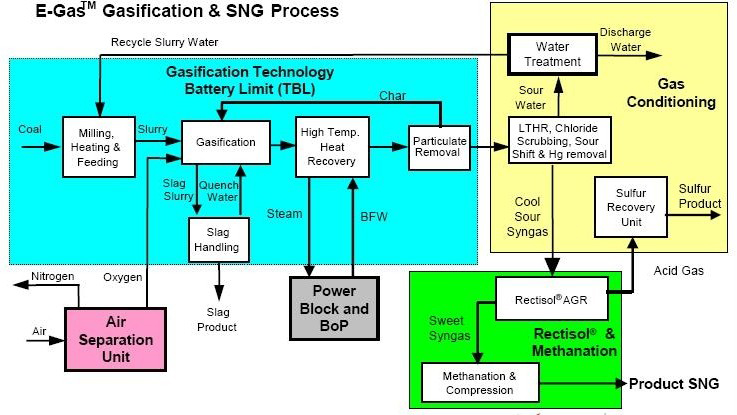
Figure 1: A Simplified Coal-to-SNG Block Flow Diagram
The economic viability of producing synthetic natural gas (SNG) through coal gasification is heavily dependent on the market prices of natural gas and the coal feedstock to be used, in addition to the capital cost of the gasification plant. Costs of producing SNG via gasifying coal were estimated by the 2007 interdisciplinary MIT study to be from 6.7 to 7.5 dollars per million Btus.
The Great Plains Synfuels Plant, which has seen gradual process improvements throughout the 25 years of operation, has an overall higher heating value (HHV) efficiency of 64.7%. This is based on 18,500 tons of lignite per day with a 6,900 Btu per lb HHV as an input and an output of 170 million standard cubic feet (scf) per day of SNG with an HHV of 972 Btu per cubic foot. In 2000, two large compressors were installed for transporting 105 million (scf) of compressed CO2 (60% of the total CO2 produced at the plant) through a 205 mile pipeline to Canadian oil fields for enhanced oil recovery (EOR). Operations during 2007 demonstrated an overall plant capacity factor of 90%.
Few industries have seen more economic ups and downs than coal. In Colorado and most of the United States, it has been mostly down for a couple decades, but it turns out that is not the case elsewhere. Not by a long ways.
Much has been made about the impacts of federal policy on the coal industry. In the West, that’s because the government owns nearly all of the land where coal is mined. But regardless of ownership, everywhere in the country federal regulation of air and water pollution has led to virtual government control over every aspect of coal mining — including when, where, and whether it can be mined at all. Thus, more attention is paid to government policies and pronouncements about coal than most other businesses.
Throughout much of the past decade opinion writers lamented what they called “the war on coal,” based on President Obama’s stated intention to end the use of fossil fuels — especially coal. It was a major campaign promise, and his administration tightened restrictions on mining (especially the strip mining common in the Appalachians), and particularly on its water and air impacts, while strongly encouraging utilities to switch from coal to natural gas or other sources. Those policies were exceedingly effective in killing a sizeable portion of the industry. They had significant help from interest groups and wealthy natural gas investors.
